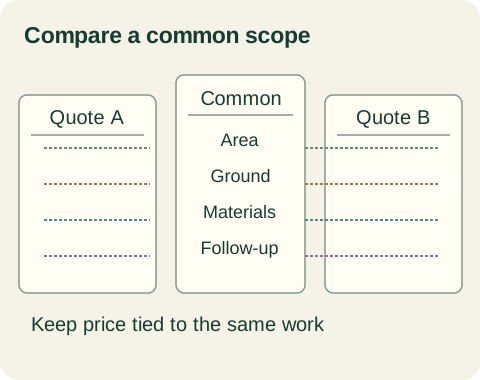
A seed package name can describe a market position without explaining the actual planting material. To compare proposals, connect the specified mix to its component information, lot identity and analysis. Then confirm whether the stated quantity is bulk seed or a pure-live-seed quantity. This guide explains the questions and accounting distinctions; it does not select a blend, certify a lot or predict how much vegetation will establish on your site.
Start with the intended vegetation specification
Ask the person responsible for plant selection to describe the goal and acceptable components. A lawn mix, forage mix, ground-cover mix and native revegetation specification are not interchangeable categories. Federal Seeds Regulations contain distinct labelling provisions for different kinds of mixtures. Keep the actual intended use beside the proposed seed documents so product selection can be reviewed in context.
Avoid treating terms such as premium, contractor or drought blend as a complete specification. Request the information needed to understand the actual material and any proposed substitutions. If a mix is unavailable, the replacement should be assessed against the vegetation objective and approved by the authorized person. A similar package colour or marketing phrase is not a documented equivalence.
Connect the analysis to the supplied lot
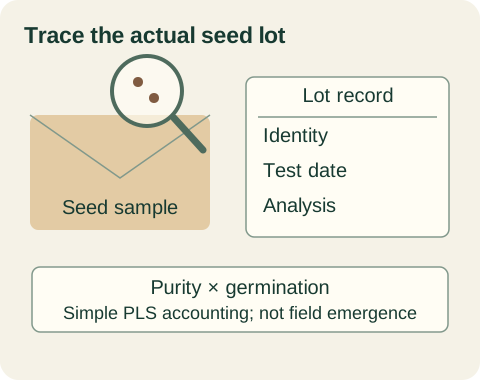
Record the supplier, product identification, lot number, analysis date and delivered quantity. Ask whether the report corresponds to the material that will actually be applied. A report for a different lot, an undated sales sheet or a photograph of an old package cannot establish the properties of the current delivery. Keep documents and package images together in the project record.
CFIA guidance explains why lot identity, sampling integrity and current test information matter. Its multiple-results guidance also notes that germination can change with time. That is a reason to request appropriate current evidence, not to choose whichever report shows the most attractive number. Resolve conflicting or incomplete documents with the supplier and responsible seed adviser before converting them into application quantities.
Understand mixture percentages
A percentage by weight describes how much mass of a component is in the mixture. It does not state the same percentage of seedlings, surviving plants or mature cover. Components can differ in seed size and growth behaviour. Keep this distinction visible when discussing an intended plant community or interpreting a quotation that lists species percentages.
CFIA's mixture guidance explains that label requirements vary by mixture category, and that component percentages are interpreted by weight. Your procurement specification may reasonably request more detail than the minimum label supplies. Agree on that requirement explicitly, rather than assuming every lawn package must display the same analysis or that a legally labelled product automatically satisfies a project's ecological goals.
Separate purity, germination and viability questions
Purity concerns the identified seed fraction in a tested sample; germination concerns performance under the specified test conditions. Ask the supplier to explain the analysis and any reported dormancy, hard seed or other viability information that is relevant to the specified species. Native seed can require interpretation beyond casually combining all percentages printed on a report.
Do not use a laboratory result as a promised field emergence rate. The site introduces moisture, placement, soil contact, weather and other conditions that the laboratory number does not resolve. A useful project file preserves both the seed analysis and the field observations. This allows a later review to distinguish an accounting assumption from evidence of what happened after application.
Follow a simple PLS calculation carefully
For a simple example using purity and germination only, express both percentages as fractions. Hypothetical purity of 95% and germination of 80% produce a PLS fraction of 0.95 × 0.80 = 0.76. Ten kilograms of that bulk seed therefore represents 7.6 kilograms of calculated PLS. These example values are invented to demonstrate arithmetic and are not a quality recommendation.
If an approved specification calls for 10 kilograms of PLS from that example lot, the corresponding bulk quantity is 10 ÷ 0.76, or approximately 13.16 kilograms. The Alberta reclamation glossary supports the underlying purity-and-germination accounting principle. A qualified adviser must confirm which analysis values are applicable; the example does not cover every species, dormancy method or mixture calculation.
Keep specification units consistent
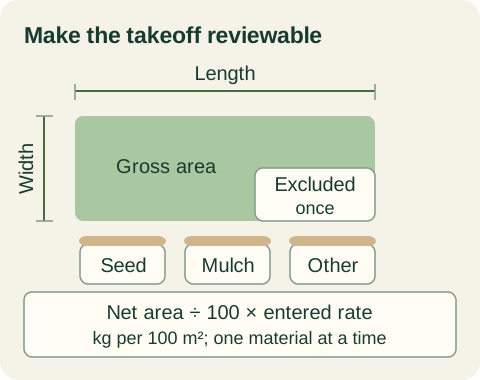
Check whether a rate is written as kilograms per hectare, kilograms per 100 m², grams per square metre or another basis. One hectare is 10,000 m², so 20 kg/ha is 0.2 kg/100 m². That is a unit conversion, not a suggested application rate. Label the original specification and the converted working value so another reviewer can reproduce the calculation.
The area planner on this portal handles one identified component using an entered bulk-mass rate. If your approved seed specification is in PLS, complete and document the appropriate lot adjustment before entering a bulk rate. Do not add a second unexplained viability allowance afterward. Mulch and other materials have their own rates and product instructions; seed arithmetic should not be reused as their application specification.
Examine weed and substitution risks
Ask for the relevant analysis information about unwanted seeds and the supplier's proposed substitutions. CFIA states that a lot with prohibited noxious weed seed identified in testing cannot be offered for sale in Canada. Provincial weed obligations and project-specific exclusions also need appropriate review. A broad statement that a product is weed-free should be connected to actual evidence and its scope.
For a native site, provenance and component identity may be central to the restoration objective. For a maintained yard, suitability for the intended use remains important. Keep approval of substitutions in writing and identify who made the decision. This prevents a change in available supply from silently becoming a change in the vegetation the owner expects to receive.
Build a seed record that remains useful
Imagine a project specification written in PLS while the delivery ticket lists bulk kilograms. The owner asks for the lot analysis and a reconciliation sheet showing the conversion. A later change of lot triggers a revised calculation instead of reusing the old amount. The final record identifies what was specified, delivered and applied, with the authorized decision attached.
Store the approved mix, lot documents, unit conversions, actual application record and any retained sample information in one place. These documents do not prove establishment, but they give a field review something concrete to examine. If cover is thin later, the conversation can use identifiable material and measured quantities rather than a package nickname recalled after the fact.
Sources + further reading
- Government of Alberta: Weed awareness for reclamation
- Government of Alberta: Reclamation glossary, seventh edition
- Canadian Food Inspection Agency: Multiple seed-lot test results
- Canadian Food Inspection Agency: Monitoring seed mixtures
- Government of Canada: Seeds Regulations
Source review: 2026-10-04. Requirements and programs can change; confirm the current details with the authority or provider.